 |
|
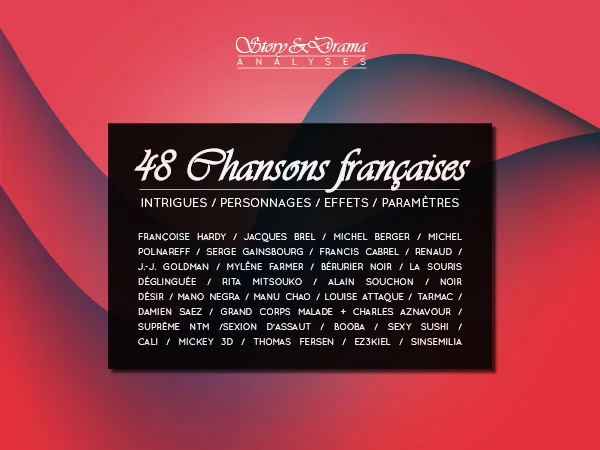
PDF, 176 PAGES, in french
|
How to write song lyrics?
Everyone knows thousands of songs, and many want to know how to write a song.
Is this true for you? If so, this e-book in PDF format has been written to provide advice and recommendations to you, the songwriter!
You can write song lyrics in any genre, any style of music, any tone:
- Pop, French variety, rock n roll, punk, rap, electro…
- Sad songs like Francis Cabrel’s C’était l’hiver or cheerful ones like Sinsemilia’s Tout le bonheur du monde, complicated or minimalist…
- Love songs, war cries, songs of revolt as in the lyrics of Damien Saez or Noir Désir…
- Very regular songs like those of Jacques Brel and Serge Gainsbourg, or resolutely non-conformist like those of Sexy Sushi…
- Portrait-songs, picture-songs, vision-songs…
However, in spite of this infinite diversity, the lyrics are always a more or less complex mixture of some basic materials, which one must know how to work:
- the narration
- the speech
- the plots
- the characters
- the themes
Lyricists, you want to learn how to write song lyrics, discover through our analysis how the lyrics of 48 French songs, among the most beautiful of the repertoire, were conceived and find inspiration for your own lyrics!
Types of song lyrics
There are several types of song lyrics:
- narrative songs, which tell a story that has one or more plots and characters
- discursive songs, which say, affirm something (for example a declaration of love or a call to revolt)
- or a mixture of both
To write a narrative song, you must first find an interesting theme, a message, and build a story around that theme and message. To build a plot that is interesting and dramatic, you can use the concepts, methods and tools presented in the two screenwriting courses.
After this scripting stage, you also need to shape the narrative material, to tell the story in a linear or non-linear way, fragmentary or complete, chronological or not, from an omniscient or subjective point of view, etc. The same story can be told in a thousand different ways!
Writing a discursive song involves choosing a genre, for example the letter (as in Louise Attaque’s La plume), the love-breakup letter (as in Mano Negra’s Pas assez de toi), and distributing the material – feelings, ideas or arguments – into the various parts of the song.
The parts of a song
The lyrics of a song are almost always divided into groups of verses, associated with parts of the music, which can be the following:
- Intro
- Purely musical or accompanied by text, the introduction sets the tone, establishes the theme, sets the mood
- Verse
- Main element of a text song, the verse tells a plot part by part in a narrative song, or presents the speech piece by piece, idea by idea, argument by argument, in a discursive song.
In a narrative song with multiple plots, like Sexion d’Assaut’s Problèmes d’adulte, each verse tells a plot.
- Main element of a text song, the verse tells a plot part by part in a narrative song, or presents the speech piece by piece, idea by idea, argument by argument, in a discursive song.
- Chorus
- The most musical part of a song, the chorus represents the heart and essence of the song. Often, the chorus delivers a message with a strong dramatic, lyrical, poetic, emotional or even political impact.
- Bridge / break
- A kind of pause or transition between verses or after a repetition of the chorus, the bridge, also known as a break, allows the suspense to linger or prolong the emotion of the song’s lyrics.
- Outro / coda
- The outro or coda is a musical part, accompanied by text or not, which ends a song by changing the melody or rhythm or mood.
Even if the classic composition Verse – Chorus – Verse is very often found, there is not really a standard model of song lyrics. All parts are optional, their number can vary enormously, giving structures as different as :
- Verse Chorus Verse Chorus Verse Chorus
- Verse Verse Chorus Verse Verse Chorus
- Chorus Verse Chorus Verse Chorus
- Intro Verse Chorus Verse Bridge Verse Chorus Outro
- etc
Similarly, the volume of text can vary greatly.
Thus, some songs like LSD’s Banzai have a very large volume of text, while others like Louise Attaque / Tarmac songs often rely on a small number of words, with blocks of phrases repeated in a loop. Some songs have a complex structure, others a minimalist structure.
How to analyze a song?
Narrative songs can be analyzed with the same tools and concepts as any other story: plots and their stages, characters and their dramatic and thematic roles, point of view and focus, management of chronology and places, distribution of dramatic information, etc.
For example, the lyrics of Jean-Jacques Goldman’s song Comme toi are narrative in nature without telling a story: they are based on the very gradual revelation of the identity of the central character, a little Jewish girl named Sarah, aged 7, who was the victim of the blind hatred of the Nazis.
Discursive songs are written with argumentation and rhetorical or poetic effects. Analyzing a discourse-based song is therefore a matter of identifying the literary devices used.
In both cases, a certain number of figures of speech are used, such as metaphor, anaphor, parallelism etc.
Often written in verse, song lyrics use rhymes and therefore rhyme systems. By noting each rhyme by a capital letter A, B, C etc, we have frequent rhyme systems like :
- AABB
- ABAB
- ABBA
- etc
Analysis of the lyrics of 48 French songs
Our analysis consists of:
- A detailed and commented summary of the lyrics, verse by verse, listing all the remarkable narrative and dramatic effects
- A detailed commentary about their plots (generally between 1 and 4 plots by song)
- A comment about their characters and their actantial and thematic roles
- A study of the story parameters: time, duration, timelines, places…
- A study of the themes related to the characters and storylines
- A study of genres, registers and colours used
- A study of focusing and points of view
- A study of figures of speech and rhetorical effects
One thing is certain: to write a good song, it is necessary to learn how to write a good story!
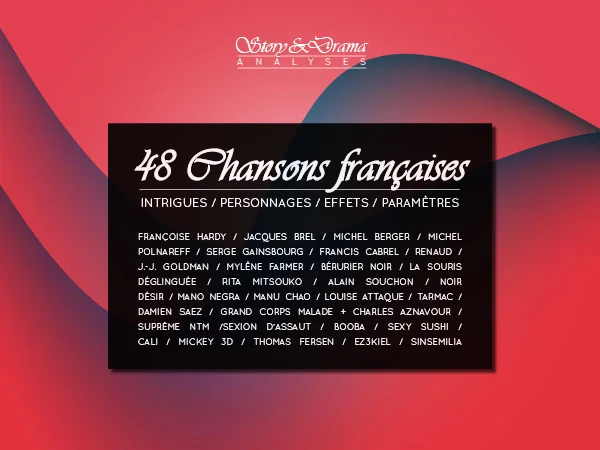
A detailed commentary on the lyrics of :
Françoise Hardy / Natacha Atlas – Mon amie la rose
Jacques Brel – Amsterdam, Mathilde
Michel Berger – Chanter pour ceux qui sont loin de chez eux, Le Paradis blanc
Michel Polnareff – Le bal des Lazes
Serge Gainsbourg – La Javanaise, Je suis venu te dire que je m’en vais, Aux enfants de la chance
Francis Cabrel – Les murs de poussière, C’était l’hiver
Renaud – Morgane de toi, Marche à l’ombre
J.-J. Goldman – Comme toi, Tournent les violons
Mylène Farmer – Libertine, Pourvu qu’elles soient douces
Bérurier Noir – Il tua son petit frère, Vive le feu
La Souris Déglinguée – Banzaï
Rita Mitsouko – La Sorcière et l’Inquisiteur
Alain Souchon – Sous les jupes des filles, Je chante un baiser
Noir Désir – Joey, Aux sombres Héros de l’amer, A ton étoile, Le vent nous portera, Le temps des cerises
Mano Negra – Pas assez de toi
Manu Chao – Le rendez-vous, Je ne t’aime plus
Louise Attaque – La plume
Tarmac – Tordu Tour du monde, International
Damien Saez – A ton nom, Fils de France
Grand Corps Malade / Aznavour – Tu es donc j’apprends
NTM – Ma Benz
Sexion d’Assaut – Ma direction, Problèmes d’adultes
Booba – Tombé pour elle
Sexy Sushi – Pétasse t’enflamme pas, Tu dégages
Cali – Sophie Calle n°108, Le droit des pères
Mickey 3D – Respire
Thomas Fersen – Deux pieds
EZ3kiel – Versus
Sinsemilia – Tout le bonheur du monde
Follow the example of the best lyricists, master their techniques, learn their tricks, and become their equal!
Excerpts from the 48 French Songs PDF
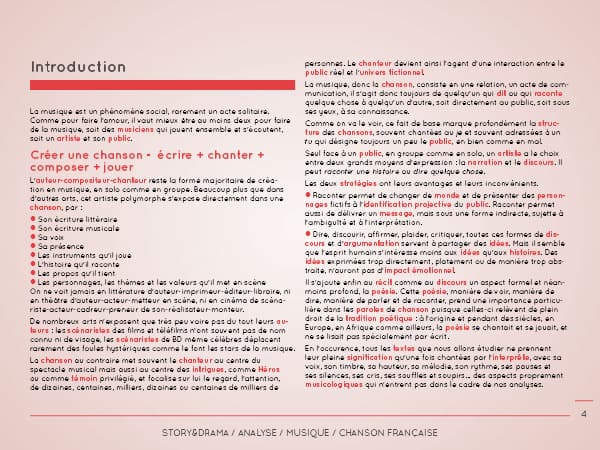
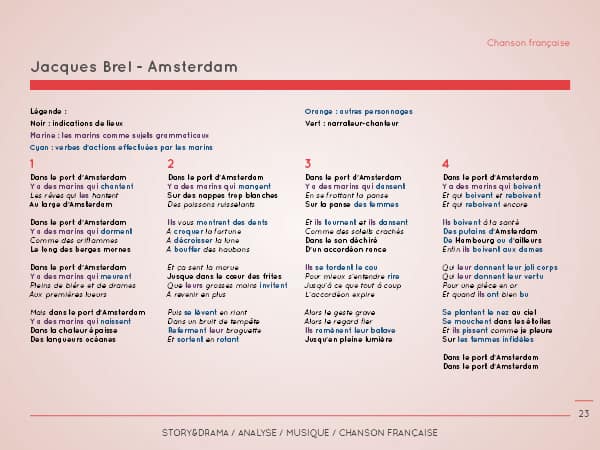
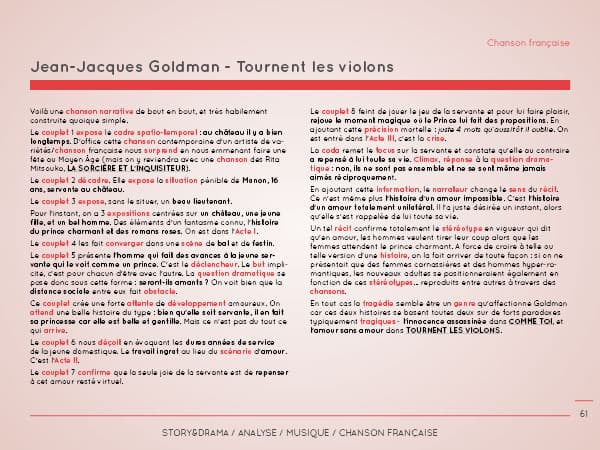
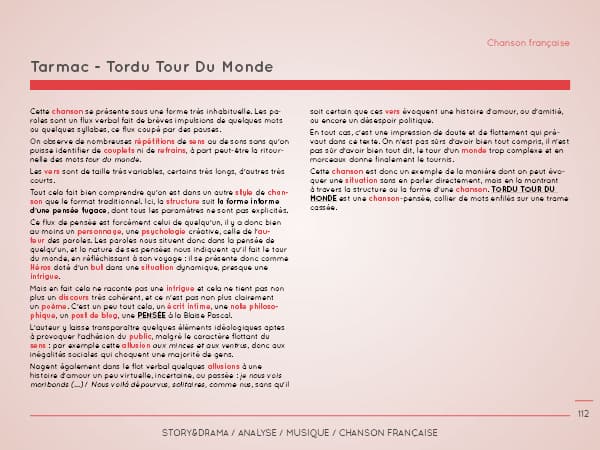
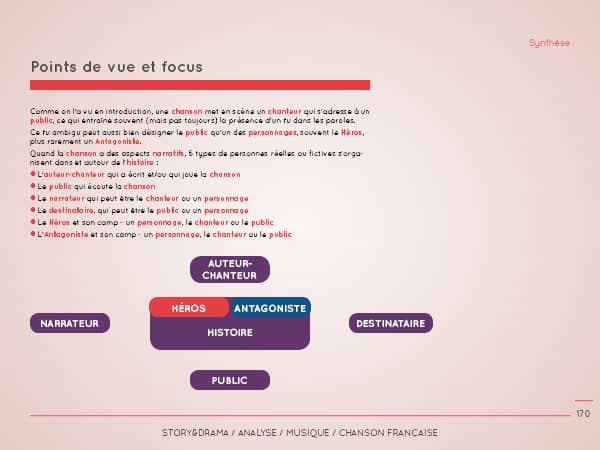
Here is what the pages of the “48 French Songs” PDF file look like:
- all technical terms are highlighted
- the song lyrics are colored to illustrate the plots they belong to, to show the main articulations and the main style or narrative effects
- at the end of the PDF, a “Synthesis” section reviews technical issues, such as point of view and focus
Enjoy your reading! Bonne lecture 🙂